How to Prepare for the CEnT-S: A Plan for Your Programme
In short. Start from your university's call. Study the sections it counts. Practise each section on its own clock. Learn when to guess.
The call (bando in Italian) is your university's admission notice. It says which sections count, and what score you need. Read it before you plan anything. See which sections count for your university.
Step 0: Match your study to your programme
In the 2026 calls, programmes fell into three groups.
If your programme counts Maths and Reasoning (economics at Tor Vergata, Trento for non-EU applicants, and Ca' Foscari):
- Put your hours into those two sections.
- The science sections do not count for this programme. If it is your only target, do not study them. Leave them blank: a blank scores 0.
- Study a science only if another programme you apply to counts it.
If it counts Maths, Reasoning and Physics (Polimi engineering):
- Study those three sections.
- Biology and Chemistry do not count for Polimi. If Polimi is your only target, do not study them.
- In 2026, at home, you could remove sections your call did not need, if the call allowed it. Otherwise, leave them blank.
If it counts every section (Sapienza Sustainable Building Engineering, Sapienza Bioinformatics, Bologna Pharmacy):
- Split your time by section size. Maths and Reasoning have 15 questions each.
- Biology and Chemistry have 10 each. Physics has 5.
- CISIA says Reading needs no special study. Practise its clock instead.
Step 1: Do CISIA's free simulation first
CISIA's practice area has free simulations.[1] In November 2025, CISIA said they had the same structure and timing as the test then. In September 2026 the menus were in Italian. Check whether yours already has the new Reading section.
Some students on Reddit who sat the test in 2026 said it felt harder than the simulation. So treat the simulation as the minimum level.
Do one simulation before you study anything. Score it by section: +1 right, −0.25 wrong, 0 blank. That shows you your weak sections.
Step 2: Learn the clocks and the guessing rule
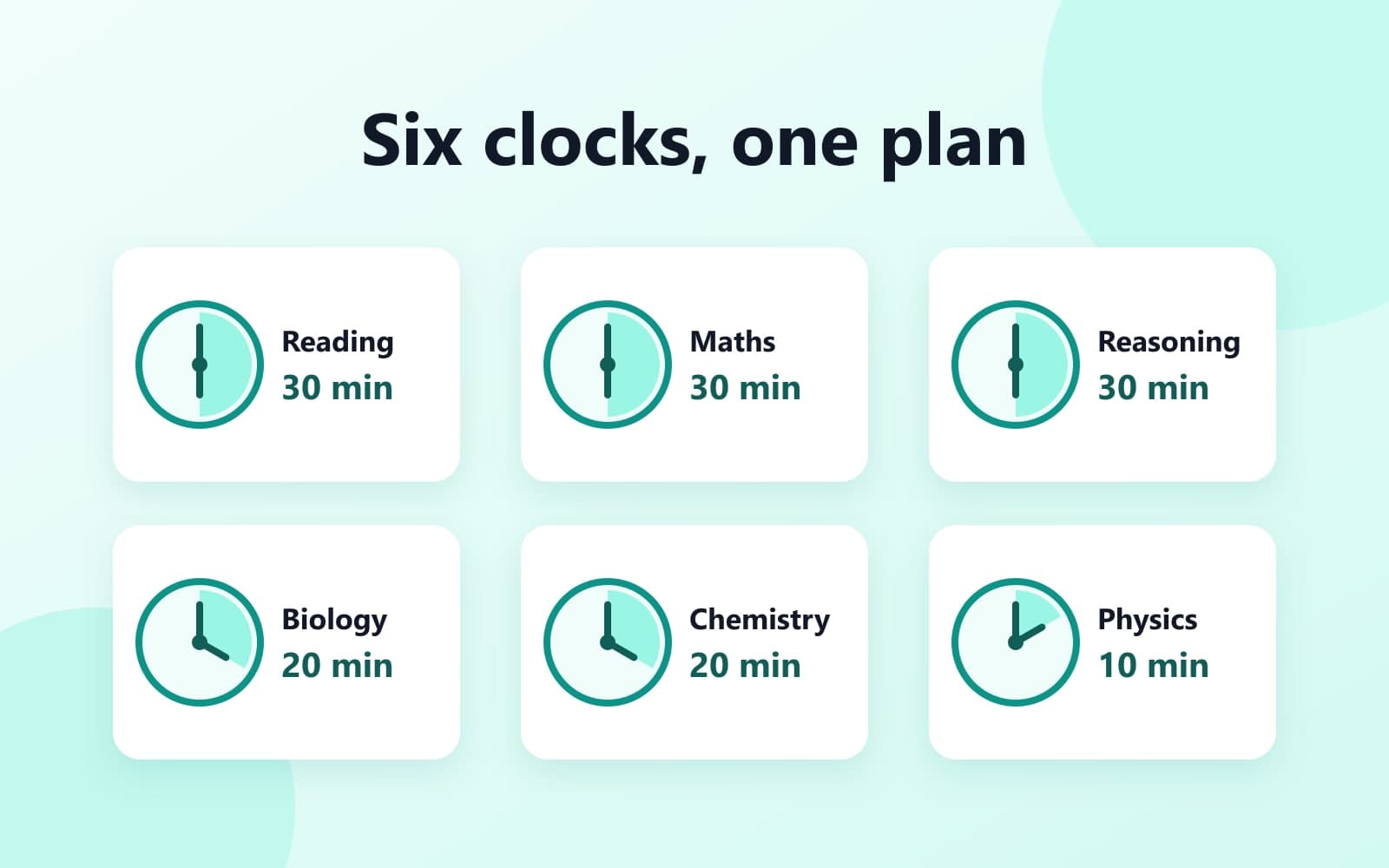
Each section has its own timer:[2]
- Reading: 10 questions in 30 minutes. That is three minutes a question, mostly reading.
- Maths and Reasoning: 15 questions in 30 minutes each. That is two minutes a question.
- Biology and Chemistry: 10 questions in 20 minutes each. Also two minutes a question.
- Physics: 5 questions in 10 minutes.
Time you do not use is lost, and you cannot go back. So practise each section on its own clock, not on one 140-minute timer.
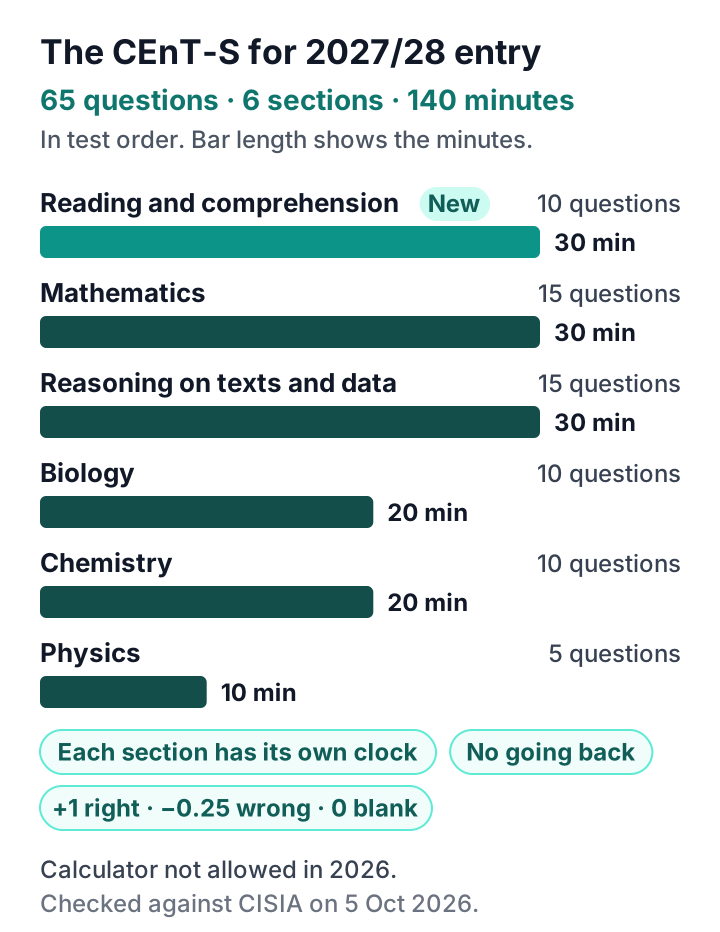
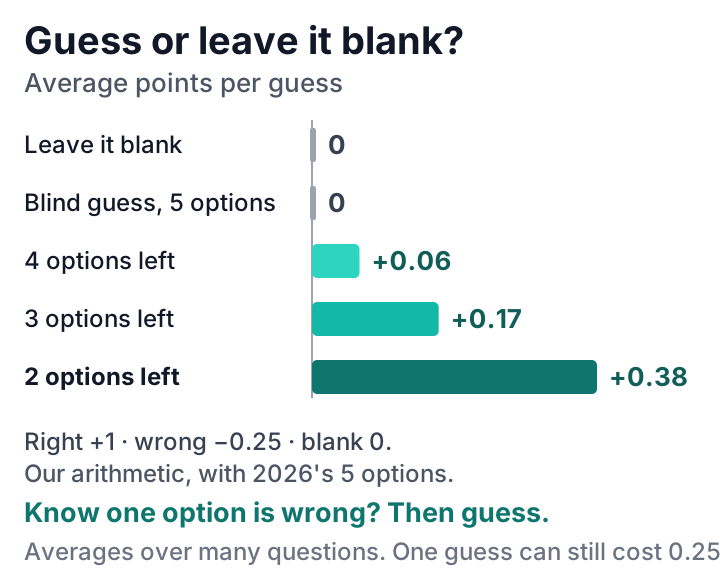
Then the guessing rule. A wrong answer costs 0.25. In 2026 each question had 5 options. So a blind guess gave 0 points on average. If you know one option is wrong, guess. The numbers are in CEnT-S scoring.
Step 3: The syllabus, section by section
This is CISIA's published syllabus, in short.[2] Open the sections that count for you.
Reading and comprehension
- English texts at B2 level: non-fiction, literary texts, and articles from newspapers and magazines.
- CISIA says no special study is needed. Practise the clock, not the content.
Mathematics
- Numbers, percentages and estimation.
- Algebra: equations, inequalities and systems.
- Geometry and coordinates.
- Functions and their graphs.
- Exponentials and logarithms.
- Counting and probability.
- Basic statistics.
In 2026 no calculator was allowed. Trigonometry is not in the Maths syllabus.
An example written for this page: estimation. Which is bigger, 2¹⁰ or 10³? Do not calculate it in the test. Know by heart that 2¹⁰ = 1,024 and 10³ = 1,000. Then many comparison questions take seconds.
Reasoning on texts and data
- Logic: and, or, not, if; all, none, at least one.
- Reading numbers from texts, tables and charts.
- Word problems with ratios, percentages and averages.
An example written for this page: necessary or sufficient. "Every student who passed had done the simulation." So the simulation was necessary to pass. It does not follow that it was enough to pass. Test questions often offer that wrong step as an answer.
Biology
- Molecules and cells.
- Cell division and genetics.
- Plants and ecology.
- The body systems of mammals.
Chemistry
- Atoms, bonds and the periodic table.
- Reactions, moles and concentrations.
- Energy, equilibrium and reaction speed.
- Acids, bases and redox.
- Organic chemistry.
Ten questions cannot cover all of this. So:
- Learn the basics of every topic.
- Do not go deep in any one.
- Practise answering in two minutes.
Physics
- Units and vectors, with sine, cosine and tangent as triangle ratios.
- Motion, forces and energy.
- Fluids and heat.
- Electricity, magnetism and waves.
Five questions in ten minutes. Practise choosing the right formula fast.
Step 4: Our suggested week plans
These are our suggestions, not CISIA rules. Each plan is one week of study. If you have six to eight weeks left, repeat it each week. Open the plan for your programme.
Every section counts (Sapienza Sustainable Building Engineering, Sapienza Bioinformatics, Bologna Pharmacy)
- Two Maths sessions: one by topic, one timed.
- Two Reasoning sessions, split the same way.
- One timed session each for Biology, Chemistry and Physics.
- One short timed Reading session.
Maths, Reasoning and Physics count (Polimi engineering)
- Two Maths sessions and two Reasoning sessions, as above.
- Two Physics sessions: formulas first, then timed sets of five.
- Biology and Chemistry: only if another programme you apply to counts them.
Only Maths and Reasoning count (economics at Tor Vergata, Trento for non-EU applicants, and Ca' Foscari)
- Three Maths sessions and three Reasoning sessions.
- Science: only if another programme you apply to counts it.
For everyone, in the last four weeks:
- One full timed test a week, in CISIA's order.
- Use CISIA's free simulations for these. Check that they include the Reading section. If not, time Reading on its own.
- If you run out of simulations, build a test yourself. Take questions from the free sources below, in CISIA's order, on six clocks.
- When CentsPrep practice opens, our full tests will be one more option.
- After each test, check every guess against the guessing rule.
Free practice you can use today
These are free and open now:
- CISIA's simulations: full tests on the real test platform. Use them for your timed tests.
- Khan Academy (khanacademy.org): free lessons and exercises in English. It covers Maths topics such as logarithms, probability and statistics. It also covers Biology, Chemistry and Physics.
- Your school books: the theory for each topic in the syllabus above.
- An old English TOLC book, if you have one: use its topic exercises, not its mock tests.
Time every set yourself. Give two minutes a question in Maths, Reasoning, Biology, Chemistry and Physics.
Short on time? A two-week plan
Is your test two weeks away? Use this plan. It is our suggestion, not a CISIA rule.
Days 1 and 2
- Read your call. Note which sections count.
- Do one CISIA simulation, on its real clocks.
- Score each section: +1 right, −0.25 wrong, 0 blank.
Days 3 to 10
- Study only the sections that count for you.
- Each day, learn one topic from your weakest counted section.
- Each day, do one timed set of questions, from the free sources above.
Days 11 to 13
- Do one full timed test, in CISIA's order.
- Check every guess against the guessing rule.
Day 14
- Rest.
- Sitting at home? Check the exam app and Webex the day before. In 2026, the app had to be installed by then.
Topics you may never have studied
One student said online that their school never covered most of the syllabus. These topics may be new to you too. The list is our pick, from CISIA's syllabus. Study only the ones in sections that count for you.
- Logarithms and exponentials (Maths).
- Combinatorics and probability: counting and chance (Maths).
- Necessary and sufficient conditions (Reasoning).
- Acids, bases and pH (Chemistry).
- Redox reactions: electrons move from one substance to another (Chemistry).
- Naming organic compounds (Chemistry).
- Fluids: the laws of Pascal, Archimedes and Bernoulli on pressure and flow (Physics).
- Galilean transformations: how speeds add when you watch from a moving object (Physics).
- Plant biology and ecology (Biology).
Step 5: Plan backwards from your score date
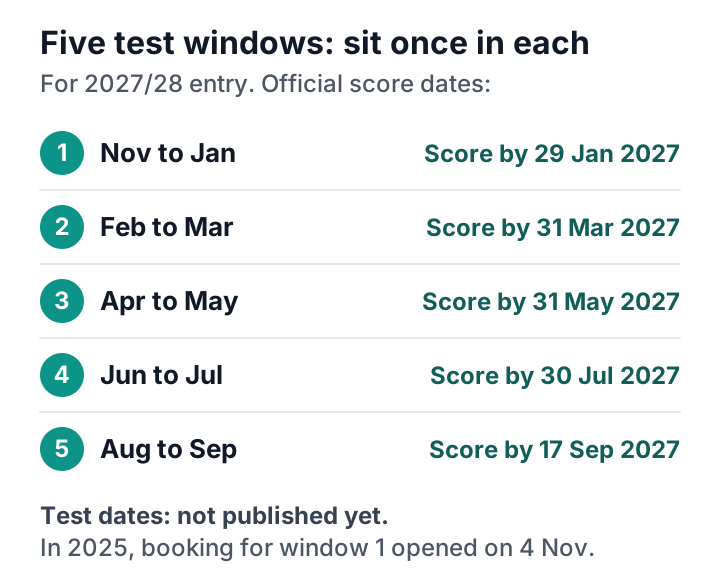
Your official score comes by your window's score date. CISIA calls the windows macro-periods. The dates are 29 January, 31 March, 31 May, 30 July and 17 September 2027.
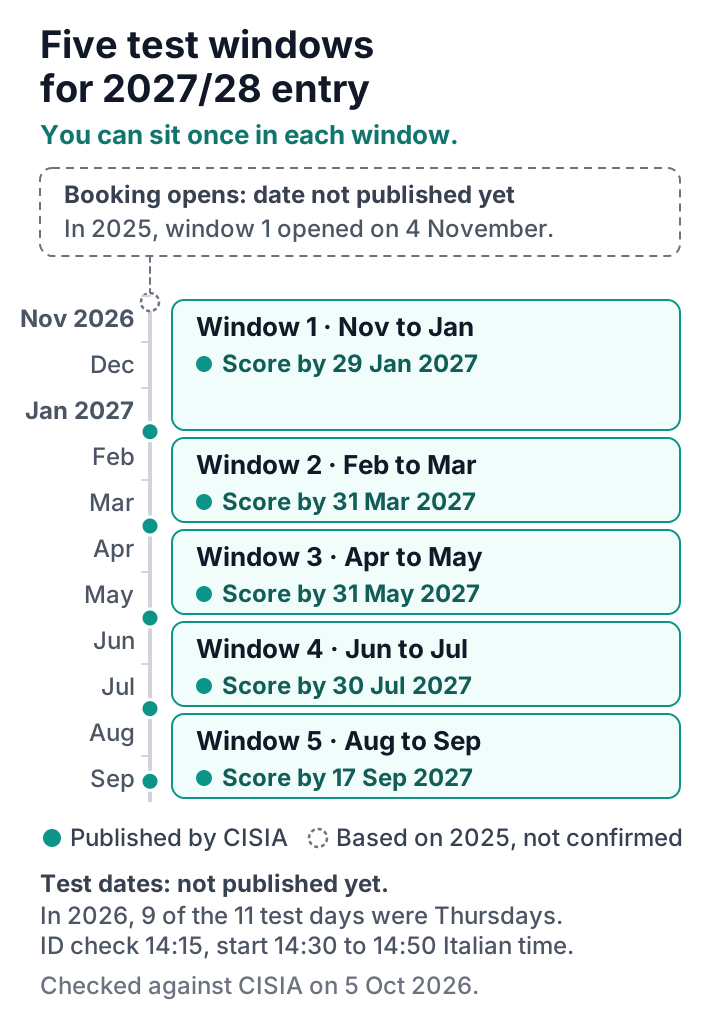
- Find your university's deadline.
- Pick the window whose score arrives before it.
- If you need the home test, book on the day booking opens for that window. In 2026, that was between three weeks and four months before the window's first test.
In 2026, Ca' Foscari said its international applicants needed a score from the first two windows.[3] Check your own deadline. Our advice: if you need a student visa, an earlier window is safer. All the dates are in CEnT-S exam dates, fee and booking.
Common mistakes
- Using a TOLC book as a mock test. The content is fine. The section sizes are not. See what changed.
- Practising on one 140-minute timer. You have six clocks, not one.
- Leaving blanks you could narrow down. If you know one option is wrong, guess.
- Studying trigonometry for Maths. There is no trigonometry in Maths. For Physics only, learn sin, cos and tan in a right triangle.
- Thinking the CEnT-S covers your English. It does not. See does the CEnT-S replace IELTS?
- Booking the last date before your deadline. On 23 April 2026, a test day failed. Tor Vergata extended its deadline. Do not count on that.
Practice access opens in November 2026.
One payment each, in euros, VAT included.
Get the printable checklist by email, with links to three guides.
Get the free guides ↓CentsPrep practice: see the plans.
Checked against CISIA on 5 October 2026.
Explore more
Read next
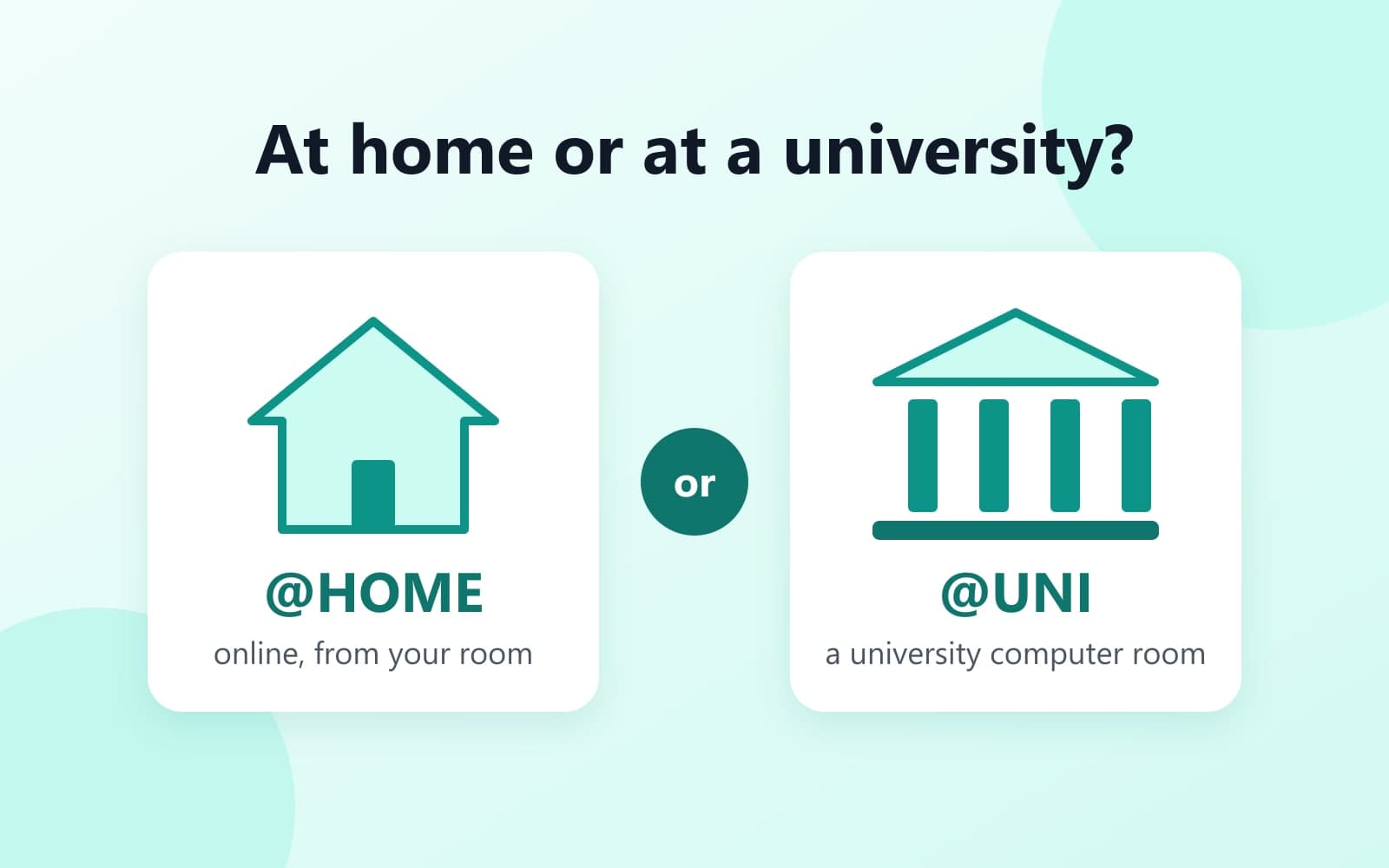
CEnT-S Online From Home or at a University: Which to Choose
Online from home (CEnT@HOME) or at a university (CEnT@UNI): what each needs, who accepts it, and how to avoid test-day problems.
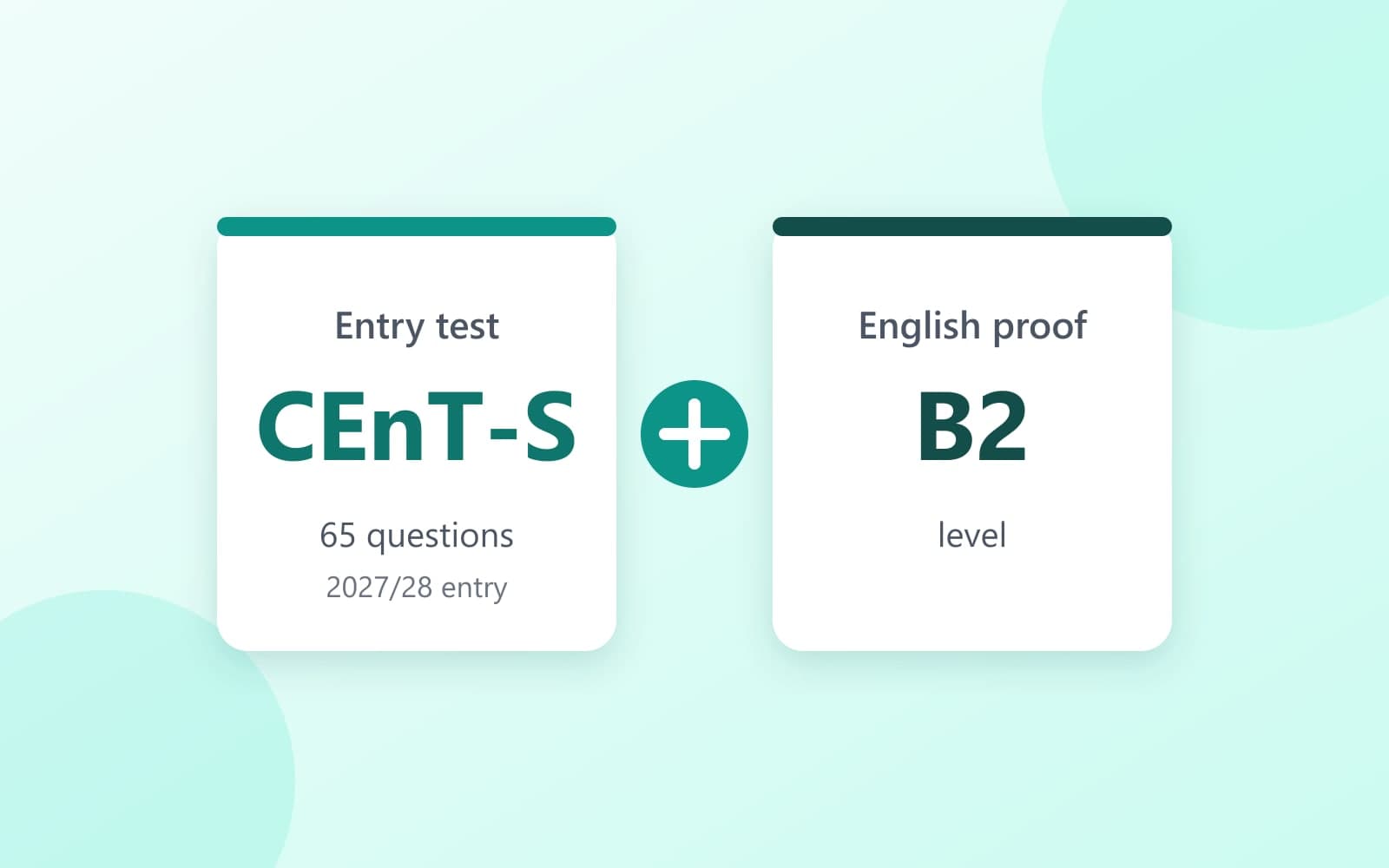
Does the CEnT-S Replace IELTS? No. Here Is What to Book
No. The CEnT-S does not prove your English. Which certificate each university asked for, and when to book.
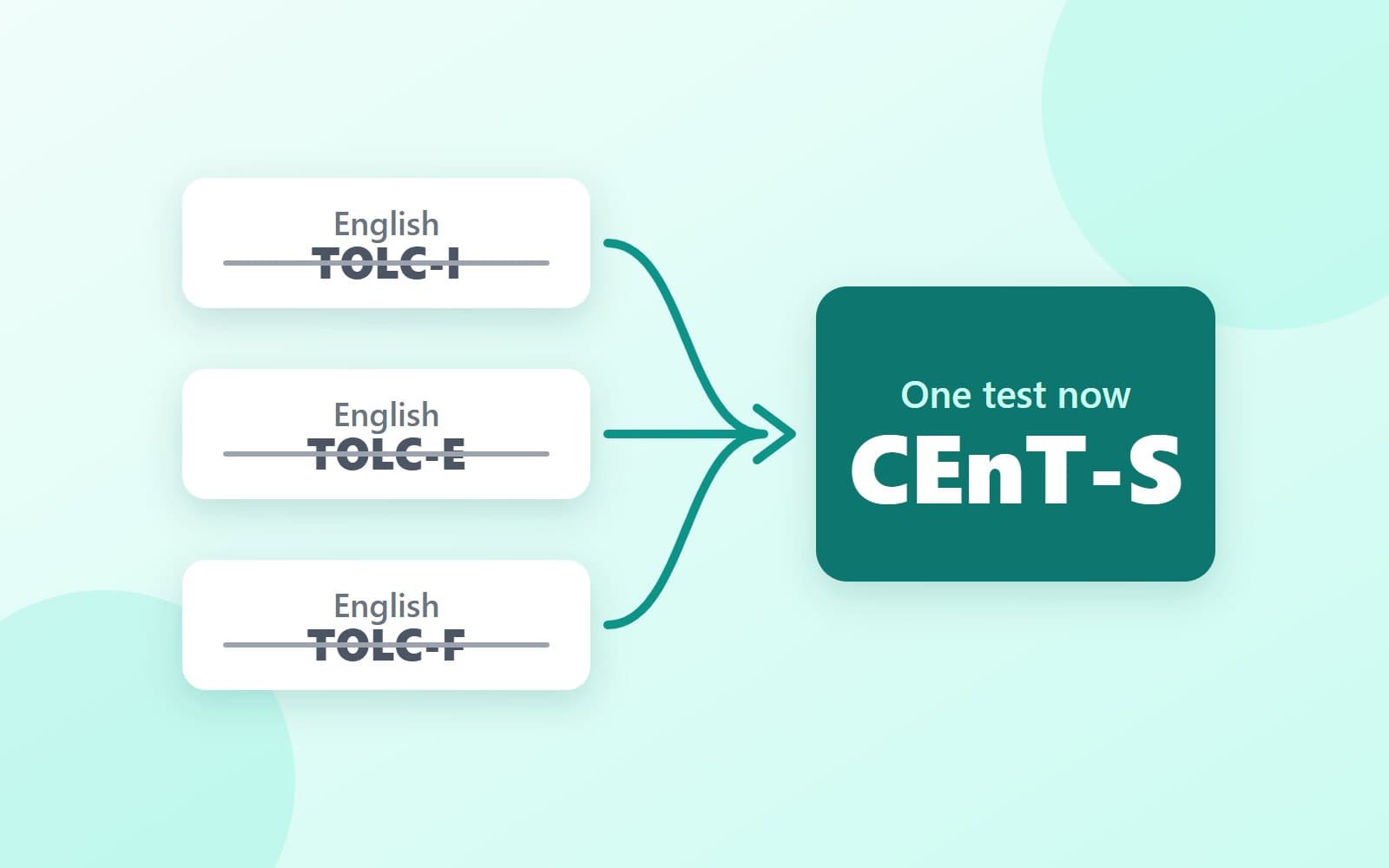
English TOLC-I, TOLC-E and TOLC-F: Replaced by the CEnT-S
The English TOLCs are gone. What replaced them, what changed, and how to reuse an old TOLC book.
Get the free CEnT-S guides
We email you today:
- A printable CEnT-S checklist (PDF, by email only): score dates, fee, sections and the home-test kit
- Which sections count for your university
- Test windows for 2027/28 entry, the fee and booking
- Your score, and when to guess
The email comes from guides@mail.prepalio.com. Prepalio is the company that runs CentsPrep. Check your Spam folder too. We email you about CentsPrep only. We do not sell your email. Ask us any time to delete it. Privacy policy.