Is the CEnT-S Score Out of 55 or 100? Scoring and When to Guess
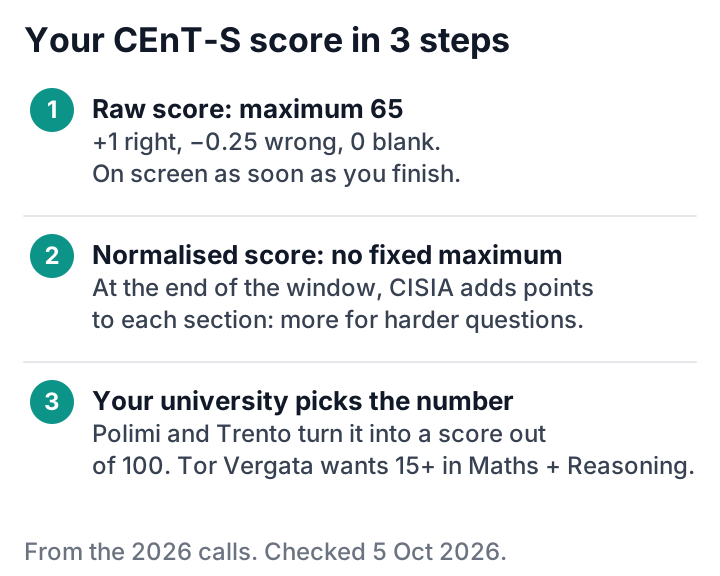
In short. Neither. There is no fixed scale. The raw maximum is 65 for 2027/28 entry (55 in 2026). CISIA then adds points to each section. Your university decides which number it uses.[1]
You get two numbers:
- Your raw score. It shows on screen as soon as you finish.
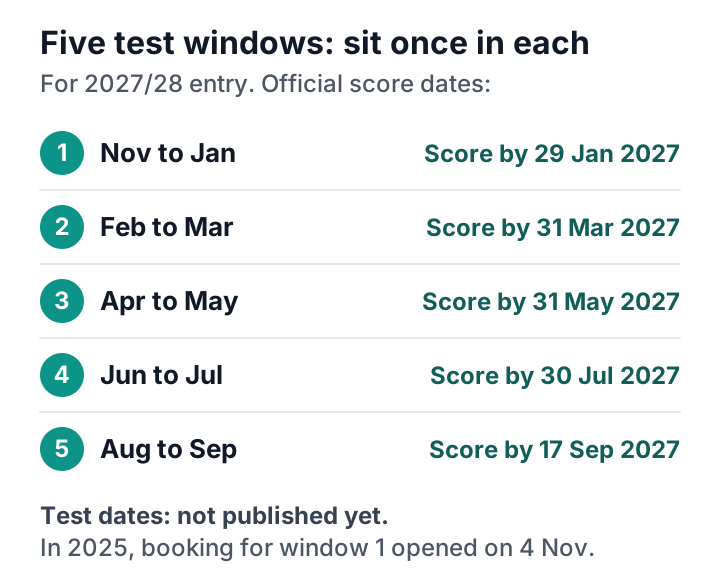
- Your normalised score. This is your score after CISIA's fairness adjustment. It comes by your window's score date: 29 January, 31 March, 31 May, 30 July or 17 September 2027.
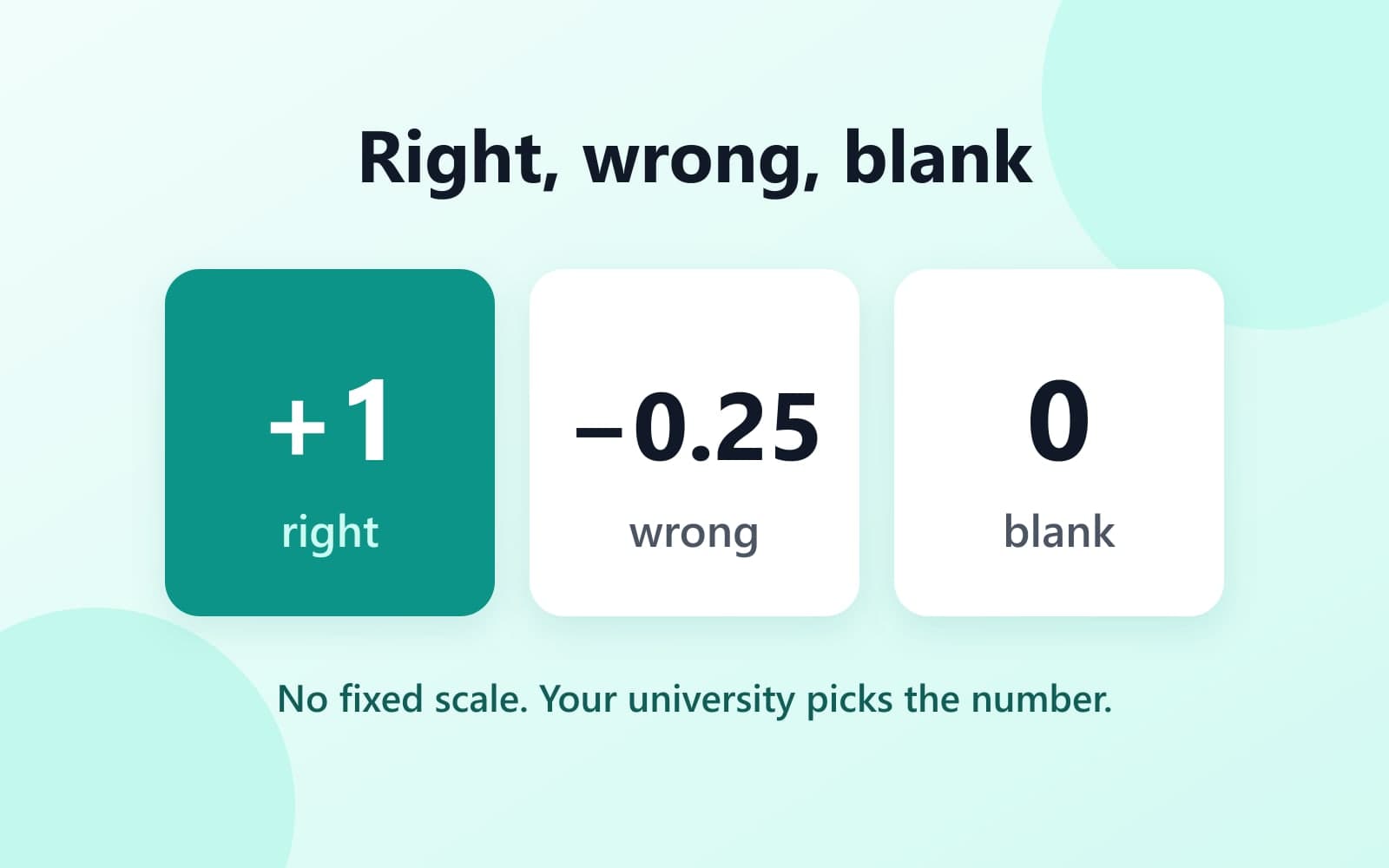
Right, wrong, blank
- A right answer gets +1.
- A wrong answer gets −0.25.
- A blank gets 0.
This is the same in every section. In 2026 each question had 5 options.[2] So a blind guess had a 1 in 5 chance of +1. It had a 4 in 5 chance of −0.25. On average, that gives 0 points.
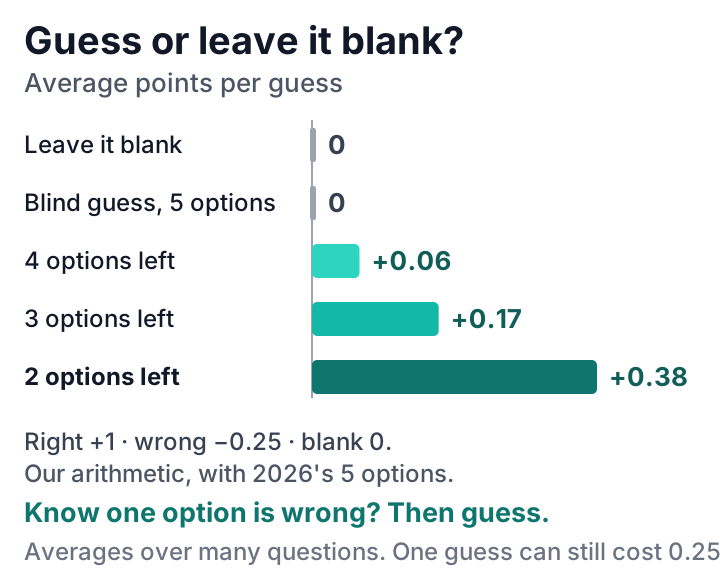
If you know one option is wrong, guessing pays on average. The more options you can cross out, the more it pays.
See our arithmetic as a table (with 2026's 5 options)
| Options left | Average points per guess |
|---|---|
| 5 (a blind guess) | 0 |
| 4 | +0.06 |
| 3 | +0.17 |
| 2 | +0.38 |
These are averages over many questions. One guess can still cost 0.25.
The rule, with 5 options as in 2026: if you know one option is wrong, guess. If you cannot cross out anything, a blank is just as good.
A wrong guess lowers that section's score. It matters only if your university counts that section, or your total.
What normalisation does
In one sentence: if most students did badly on your questions, CISIA adds more points to your score.
Normalisation is CISIA's fairness adjustment. People can get different questions. So CISIA adds points to each section, and more for harder questions. It does this at the end of each test window, not once a year.[1]
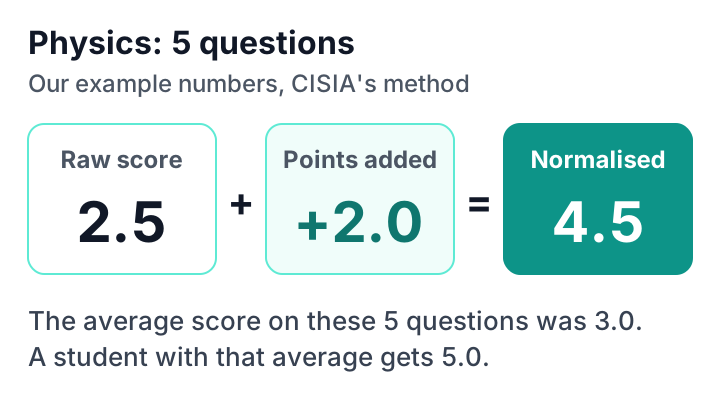
An example, step by step (our numbers, CISIA's method):
- Physics has 5 questions.
- You get 3 right and 2 wrong. Your raw score is 3 − 0.5 = 2.5.
- On these 5 questions, the average student scored 3.0 out of 5.
- So CISIA adds 5 − 3.0 = 2.0 points to the Physics score of everyone who had them.
- You end with 2.5 + 2.0 = 4.5.
After the adjustment, a student with the average score gets 3.0 + 2.0 = 5.0 here. That is the same as the number of questions. You got 4.5, so you were a little below average. Above 5.0 means better than average on those questions.
The points added are never negative. But a section score can still be negative. For example, 15 wrong answers in Maths give −3.75 before the adjustment.
How CISIA calculates it
- At the end of each window, CISIA looks at every question.
- For each question, it takes the average score of everyone who had it.
- It adds up those averages for the questions in your section.
- It takes the number of questions minus that total. It adds the result to your raw section score.
- Your total is the sum of your six sections.
What is a good score?
There is no pass mark. CISIA sets none. Each university sets its own rule in its call. The call (bando in Italian) is its admission notice. It also says which number it uses: raw or normalised.
Here are the rules in the 2026 calls:
| University · programme | Number used | Mark needed |
|---|---|---|
| Tor Vergata · Business Administration and Economics | Normalised Maths + Reasoning | 15 or more for the interview |
| Trento · Economics and Management, non-EU | Maths + Reasoning, rescaled to 100 | 60 |
| Sapienza · Bioinformatics | Raw total | Over 18 |
| Sapienza · Sustainable Building Engineering | Normalised total | Below 18 means an OFA in Maths |
| Teramo · Business Management | Right answers in Maths and in Reasoning | Below 3 in Maths or 2 in Reasoning means an OFA |
| Polimi · Engineering | A TOL score out of 100, without Biology and Chemistry | Polimi's TOL minimum, on its own page |
| Bologna · Pharmacy | Normalised total, in a ranking for 100 places | At least 5 to enter the ranking (ordinary intakes). Below 15 means an OFA |
For a ranking, the score you need depends on who else applies. Bologna's 5 was only the floor. So no fixed number is safe. Aim as high as you can in the sections that count.
- An OFA is an extra requirement if you score low: a course or a test. Your call says in which subject. It is not a rejection.
- Rescaled to 100 means turned into a score out of 100.
- TOL is Polimi's own entry test, scored out of 100. In 2026, Polimi turned your CEnT-S Maths, Reasoning and Physics into a TOL score. Polimi's CEnT-S page gives its formula and its minimum. To set your target, put your section scores into that formula. Then compare the result with the minimum. Check both there for 2027/28 entry.
See all the rules, with links to each call, in which sections count for your university.
The clocks
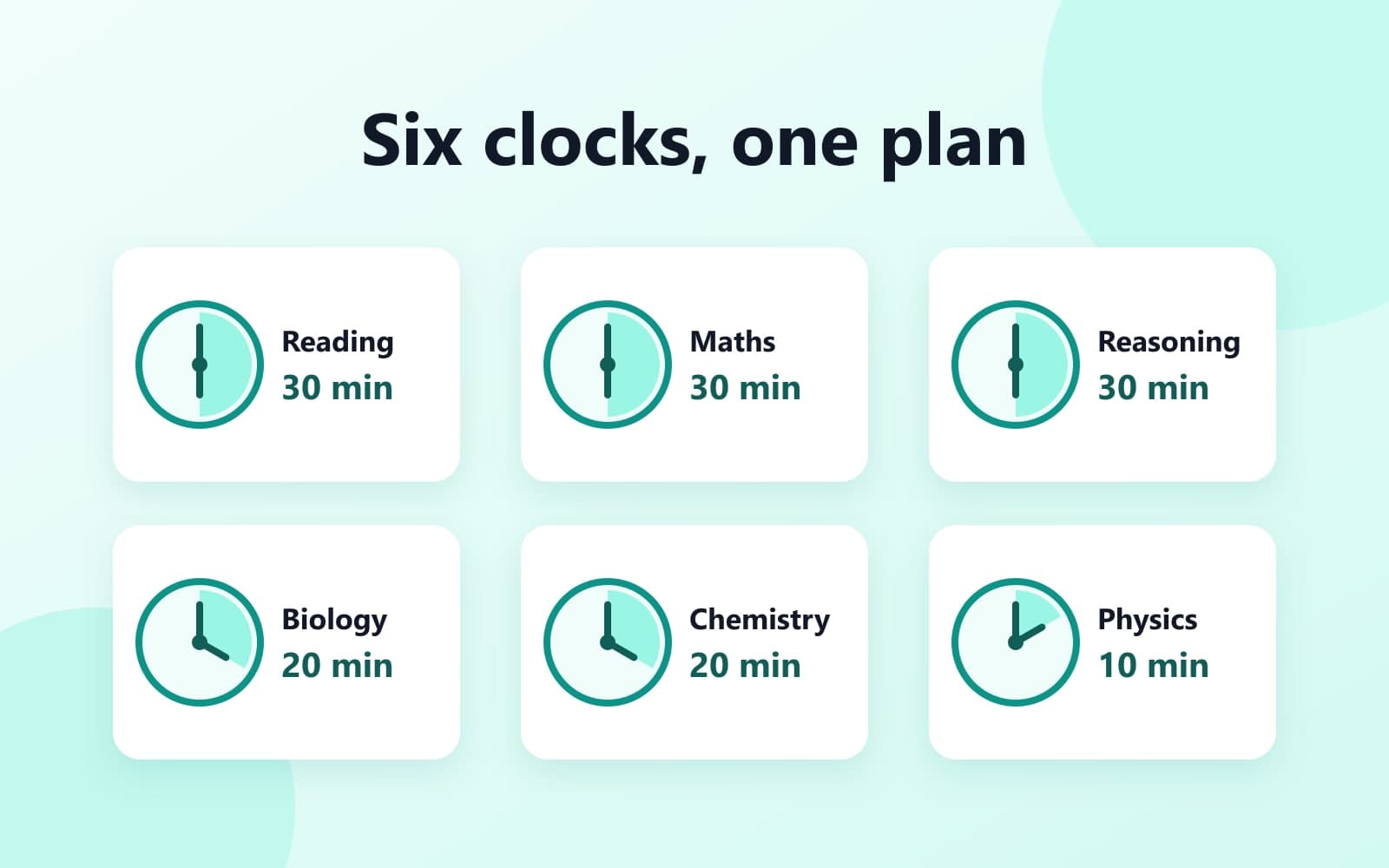
Each section has its own timer. You cannot go back to a section you have closed. Time you do not use is lost.[1]
In 2026 you had to stay a minimum time in each section. You could not move on before it passed. CISIA has not confirmed this rule for 2027/28 entry. Our advice: plan as if it still applies.[3]
If the test feels hard, keep going
Harder questions get more points added at the end of the window. So a hard test is partly made up for. Keep going, and use the guessing rule.
Our practice tests will score +1, −0.25 and 0, like CISIA. Get the free guides by email below.
Get the free guides ↓CentsPrep practice: see the plans.
Checked against CISIA on 5 October 2026.
Explore more
Read next
How to Prepare for the CEnT-S: A Plan for Your Programme
A study plan built on your programme: which sections to study, the free simulation, clocks, guessing and a week plan.
CEnT-S Online From Home or at a University: Which to Choose
Online from home (CEnT@HOME) or at a university (CEnT@UNI): what each needs, who accepts it, and how to avoid test-day problems.
Does the CEnT-S Replace IELTS? No. Here Is What to Book
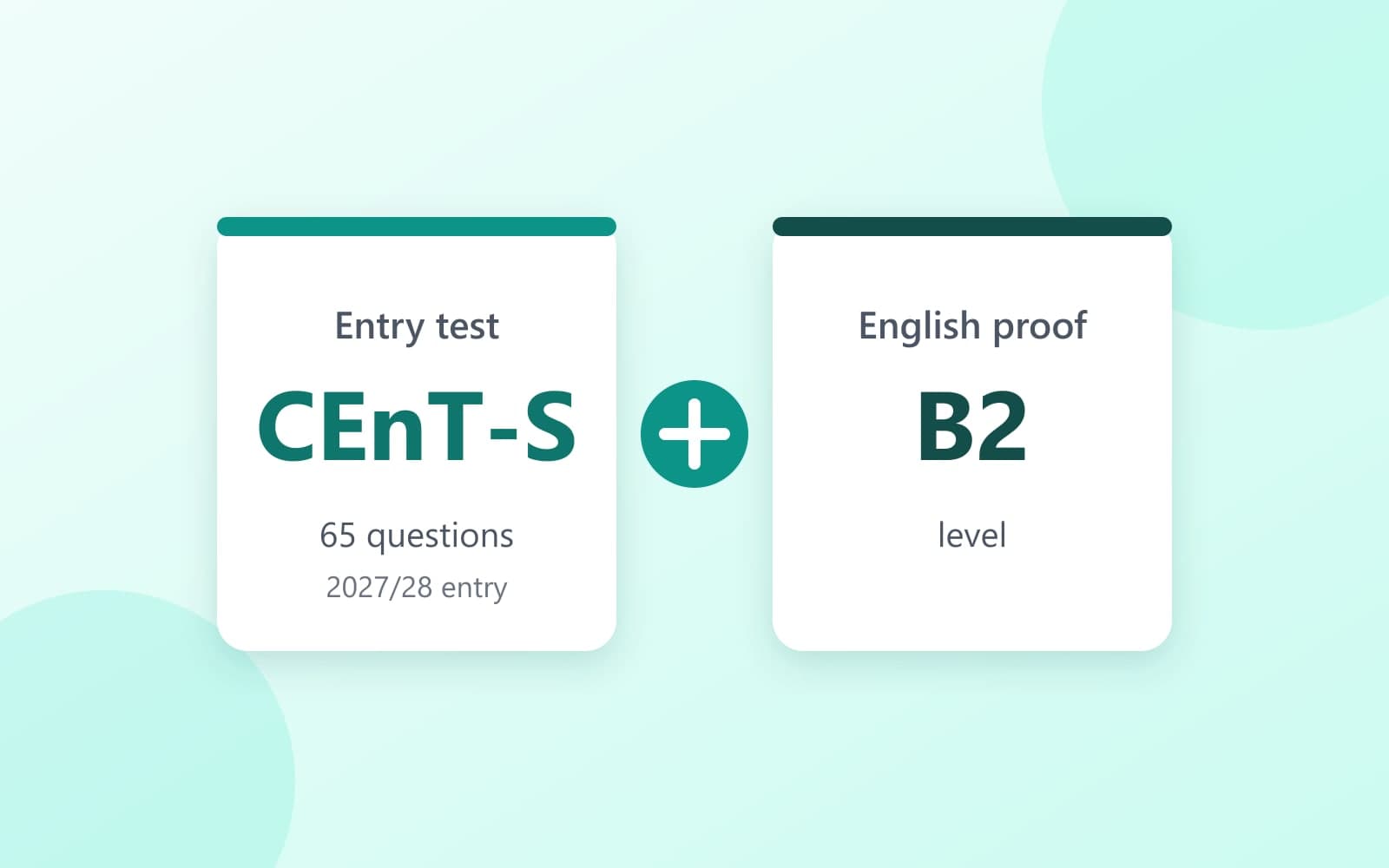
No. The CEnT-S does not prove your English. Which certificate each university asked for, and when to book.
Get the free CEnT-S guides
We email you today:
- A printable CEnT-S checklist (PDF, by email only): score dates, fee, sections and the home-test kit
- Which sections count for your university
- Test windows for 2027/28 entry, the fee and booking
- Your score, and when to guess
The email comes from guides@mail.prepalio.com. Prepalio is the company that runs CentsPrep. Check your Spam folder too. We email you about CentsPrep only. We do not sell your email. Ask us any time to delete it. Privacy policy.